
Apple Watch Series 11 versus Series 10 Technical Comparison and Upgrade Analysis
Introduction
The Apple Watch Series 11 supersedes the Series 10 with targeted refinements rather than wholesale redesign. Physical dimensions remain largely unchanged, while incremental upgrades focus on materials, connectivity and battery management. This technical comparison examines hardware, sensors, power systems and software behavior to inform upgrade choices.
Executive summary
Apple retained the Series 10 mechanical form factor and the S10 system-in-package for Series 11, yet introduced changes in materials sourcing, display cover composition, and cellular modem capabilities. Battery endurance claims have increased, driven primarily by firmware-level power management rather than a disclosed change in cell capacity. Screen technology is consistent across both models, but glass composition differs by finish. Sensor arrays and core health-monitoring features are identical.
Short assessment.
Series 11 is an incremental update focused on materials and connectivity rather than core processing performance.
Pricing and SKU options
Base pricing for the aluminum Series 11 begins at $399. Titanium models start at $699. Size and connectivity choices alter MSRP: opting for the larger 46mm aluminum adds approximately $30; choosing the 46mm titanium adds about $50. Cellular capability incurs a $100 premium versus GPS-only models. Premium bands and the Hermès titanium variant further increase the total cost, with a Hermès titanium option listed from $1,249.
Apple has ceased direct sales of new Series 10 units, but refurbished and remaining-new inventory is available through select retailers and Apple’s refurbished channel. For procurement teams or consumers attempting to maximize value-per-dollar, the presence of Series 10 inventory at reduced pricing alters the upgrade calculus.
Physical design and materials
Both Series 11 and Series 10 present a rectangular case with two size options: approximately 46mm x 39mm for the larger case and 42mm x 36mm for the smaller. Case thickness for both models is 9.7mm. Apple continues to offer two material families: aluminum and titanium.
Dimensions, mass and finishes
Mass differences are minor. The 46mm aluminum Series 11 with GPS weighs roughly 37.8 grams, compared with 36.4 grams for the Series 10 equivalent. Small-case variants show similarly marginal mass changes. Finish choices include multiple aluminum colors and titanium finishes. Notably, the titanium Series 11 shifts to 100% recycled titanium content, an increase from the 95% recycled material used in Series 10 units.
Environmental and material notes
Series 11 introduces higher recycled-material percentages for several components: the titanium case moves to 100% recycled titanium; display glass for Series 11 contains 40% recycled glass; and the battery incorporates 100% recycled cobalt and 95% recycled lithium. These changes affect supply-chain sourcing and may influence lifecycle assessments.
Display and durability
Both models employ wide-angle LTPO3 OLED Retina displays. The LTPO3 implementation supports variable refresh, including an always-on update frequency down to once per second for second-hand movement in inactive mode. Peak luminance is specified up to 2,000 nits, and minimum brightness scales to 1 nit.
Cover glass distinction
The primary divergence in the optical stack is the cover glass. Aluminum Series 11 models use Ion-X glass stated to be twice as scratch-resistant relative to previous aluminum glass. Titanium variants retain sapphire crystal. The Series 10 did not specify recycled glass content; Series 11 lists 40% recycled glass for its display covering. Impact resistance, scratch susceptibility and long-term abrasion performance will depend on exact use patterns and protective measures.
System architecture and performance
The Series 11 continues to deploy the S10 SiP architecture found in Series 10. The SoC features a 64-bit dual-core design, a four-core Neural Engine, and integrated W3 wireless components. Onboard storage capacity is 64GB.
Performance expectations for general user workflows remain consistent between the two models due to identical primary silicon. Any observed responsiveness improvements in Series 11 should be attributed to firmware and operating-system-level optimizations rather than raw CPU or GPU advances.
Peripheral chips
Communications and location subsystems include the W3 Apple wireless chip and the second-generation Ultra Wideband module for precise Find My positioning. Bluetooth 5.3 is present on both models, and Wi-Fi support covers 802.11n at both 2.4GHz and 5GHz bands.
Battery performance and charging
Apple specifies up to 24 hours of typical use for Series 11, an increase from the 18-hour figure listed for Series 10. In Low Power Mode the Series 11 rating is up to 38 hours, compared with 36 hours on Series 10. Apple does not publish cell capacities, making direct energy-density comparisons impractical; the extension in runtime is likely attributable to software-level power management and system-level tuning.
Real-world testing reported multi-hour margins above rated endurance under typical mixed-use scenarios. For example, continuous notification traffic combined with daily workouts and overnight sleep tracking produced runtimes in the high 20-hour to low 30-hour range on Series 11 hardware.
Fast charge behavior
Both Series 11 and Series 10 fast-charge to approximately 80% in 30 minutes and to full charge in about 60 minutes. Apple lists use cases for short fast-charge intervals: a 15-minute charge (with a 20W adapter) can provide roughly 8 hours of regular use, and 5 minutes of charging is sufficient to power 8 hours of sleep tracking. These metrics are relevant for operational planning where limited downtime is available.
Sensors and health monitoring
Sensor arrays are functionally identical across Series 11 and Series 10. Data capture capabilities include ECG, a third-generation optical heart-rate sensor, skin temperature, SpO2 monitoring, a depth gauge, and noise-level monitoring. Additional environmental sensors include water-temperature sensing and a compass.
Health and safety features such as Fall Detection, Crash Detection, Emergency SOS and Satellite SOS are present on both platforms. The equivalence of sensors indicates parity in raw physiological input; differences in analytic output are therefore dependent on firmware and watch OS algorithms rather than hardware divergence.
Connectivity and software
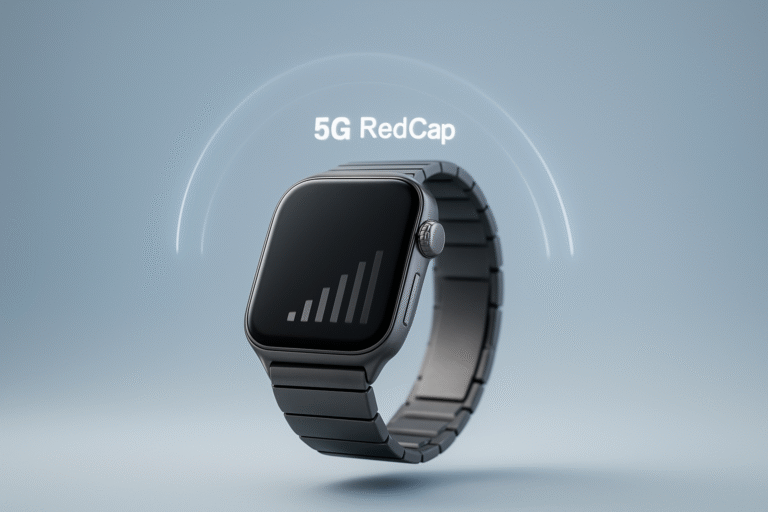
A primary architectural advancement in the Series 11 is cellular connectivity: Series 11 cellular models introduce 5G Reduced Capacity (5G RedCap) support. This is a power-efficient subset of 5G intended for wearables and IoT endpoints, offering improved throughput relative to LTE without full 5G device complexity. Series 10 cellular models are limited to LTE and UMTS (3G).
Series 11 integrates a redesigned cellular antenna and an algorithmic approach that can simultaneously engage dual system antennas to increase signal strength when required. Apple indicates that the dual-antenna algorithm is exclusive to Series 11 and Apple Watch Ultra 3.
Both models support watch OS 26 features, including hypertension notifications, Sleep Score metrics and the Blood Oxygen application. Cross-model feature parity is extensive; some marketing materials highlighted new gesture inputs for Series 11, but those gestures appear supported on Series 10 hardware as well.
Inter-device communications
Bluetooth 5.3 enables peripheral connections and servicing from paired iPhone units. Wi-Fi connectivity includes both legacy 2.4GHz and 5GHz operation. Ultra Wideband supports precise location tracking for Find My and related features.
Upgrade decision framework and conclusion
Decision criteria cluster into three principal vectors: connectivity needs, battery performance, and material/environmental priorities.
– Connectivity-driven upgrades: If independent cellular performance and higher mobile bandwidth on the watch are critical, Series 11 cellular models provide 5G RedCap capability and improved antenna algorithms that can materially affect signal robustness. Organizations deploying watches for untethered field use should prioritize Series 11 cellular SKUs.
– Battery and operational cadence: The Series 11 presents an improved endurance envelope, particularly in low-power modes and under mixed-use conditions. For users needing more than a single day of resilience or those relying on fast top-ups during brief idle windows, Series 11 offers practical runtime advantages.
– Materials and lifecycle concerns: The increase in recycled-content percentages for titanium, display glass and battery components may influence procurement specifications that incorporate sustainability criteria. For procurement requiring higher recycled material content, Series 11 titanium models meet stricter thresholds.
If the primary requirement is raw compute performance or additional sensors, there is little incentive to upgrade from Series 10 to Series 11, given identical SoC and sensor suites. Conversely, if improved cellular performance, marginally better battery runtime, or higher recycled-material content align with operational objectives, Series 11 represents a measured upgrade.
Final technical assessment: Series 11 refines materials and connectivity while maintaining core processing and sensing parity. Purchase decisions should map to explicit requirements rather than perceived general-purpose performance gains.
Ready to Choose Your Apple Watch?
Both the Apple Watch Series 11 and Series 10 are excellent options — the right choice depends on whether you want the latest features or the best value.
-
Choose the Series 11 if you want longer battery life, 5G cellular support, improved display durability, and Apple’s newest smartwatch experience.
-
Choose the Series 10 if you want nearly the same features at a lower price while supplies last.
👇 Use the links below to check current pricing and availability:
👉 View Apple Watch Series 11 Deals
Check it out on Amazon
👉 View Apple Watch Series 10 Deals
Check it out on Amazon
Disclosure: This page may contain affiliate links. If you make a purchase through these links, I may earn a commission at no extra cost to you.